
For years, the playbook for reducing food waste in university canteens looked the same everywhere: a poster on the wall, an announcement over the speakers, a campaign urging students to clean their plates. A member of Champions 12.3, China Agricultural University (CAU), decided to test a new hypothesis — that students don't waste food because they don't care, but because they can't see what they're wasting. By making waste visible, the university cut food waste by 48.5% in two years.
The Problem
Food waste in Chinese university canteens isn't a minor inefficiency — it's a crisis that's getting worse. Research by CAU's Global Food Economics and Policy Research Institute (AGFEP), based on a survey of four Beijing universities conducted between October and December 2023, found that students waste an average of 94.76 grams of food per meal. Of that, 74.83 grams are still perfectly edible. That's significantly higher than the 67.55-gram national average recorded in 2018, a sign the problem is accelerating, not easing.
Vegetables make up the largest share of edible waste (44%, or 32.79g per meal), followed by staple foods like rice and noodles (39%, or 29.12g) and meat (11%, or 8.40g). Scaled across Beijing's 1.39 million university students over a nine-month academic year, this amounts to roughly 230,000 tonnes of CO₂ emissions annually, driven entirely by avoidable waste in student cafeterias.
The pressure to act was both legal and practical. China's Anti-Food Waste Law (2021) and Food Security Guarantee Law (2023) imposed new obligations on institutions, including universities, to actively reduce waste. But CAU's own research pointed to an uncomfortable truth: the traditional toolkit wasn't working. Posters, announcements, and even the well-known "Clean Plate Campaign" (光盘行动) had shown only a limited effect. Passive exposure to information, the data suggested, simply didn't change student behavior in the moment of decision. A more active, evidence-based approach was needed, so CAU set out to design, test, and evaluate one through controlled experiments between 2023 and 2025. The goal was ultimately to build a model that other universities could adopt as well.
The Action
CAU's response paired two interventions that are usually pursued separately: behavior change and infrastructure changes. On the behavioral side, the university kept the awareness work going — banners, posters, promotional videos — but added mechanisms designed to make those better habits stick. Student associations led dedicated waste-reduction activities. They added a "clean plate check-in" program (光盘打卡活动) that lets students log and share their empty plates, building social accountability into the routine. Some initiatives rewarded diners who finished their meals, turning a vague aspiration into a small, repeatable win.
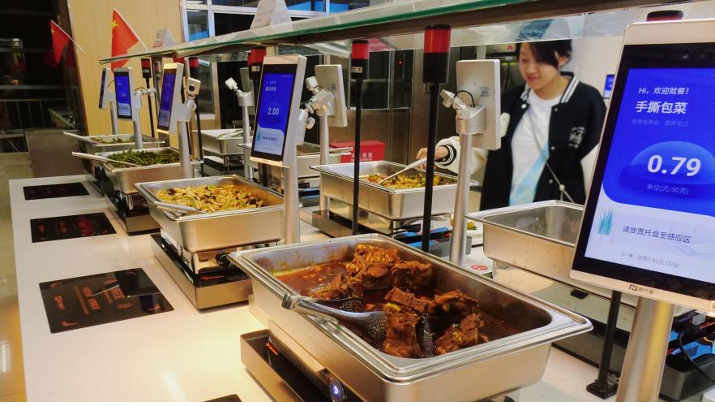
The more significant infrastructure shift came in December 2023, when CAU introduced AI-enabled digital canteen infrastructure. Using image recognition, real-time data capture, and large-scale consumption analytics, these systems changed how students engage with food at the point of service. Diners can see nutritional information and real-time pricing for every item on their tray, helping them make more deliberate choices about portions and selections before they sit down. For cafeteria managers, the same systems generate consumption data that enables precision procurement — cutting over-preparation in the kitchen before waste ever reaches a plate. The work was made possible in part through a partnership with the Vanke Foundation, whose support allowed CAU to conduct the research and deploy the technology at scale. The effect was to shift waste reduction from the posters on the wall and into the eating experience itself. It stopped being a message students were asked to remember and became a fixture of their daily meals.
The Outcome
Between 2022 and 2024, average food waste in participating cafeterias fell by 48.5%. Neither the behavior-change campaigns nor the technology alone delivered that result. It came from the two working together, the technology infrastructure giving the behavioral nudges something concrete to act on. When students could see, in real time, the nutritional content and cost of what they were eating, food became something to engage with rather than consume on autopilot. Many reported noticing waste patterns in themselves that they'd never noticed before.
For cafeteria managers, AI-driven demand forecasting eased the constant pressure to over-prepare, lowering costs, cutting kitchen-level waste, and improving the freshness of what's served. The data trail also gave managers something they'd never had: hard evidence to justify further investment in waste reduction.
"Seeing a 48.5% reduction in food waste over two years made us realize that the gap between intention and action is smaller than we thought. Students care about food waste and want to change — they just need the right information in front of them. When the digital canteen showed them, in real time, the nutritional value of what was on their tray, they naturally made better choices. The technology didn't impose change. It invited it." —Shenggen Fan, CAU
What’s Next
CAU is candid that the approach took work to get right. The upfront investment was significant, and coordinating cafeteria management, technical staff, and university administration took time. There was an adjustment period for diners, too — when the system launched, students needed time to learn the new interfaces, and queue times briefly rose before efficiency improved and satisfaction climbed.
The university's advice to others considering the same path is shaped by that experience: expect early friction and don't mistake it for failure; measure who is wasting what, and why, before designing any intervention; involve cafeteria managers early, since the best ideas often come from the kitchen and the managers who own the data sustain the effort; and make better behavior easy and rewarding. Next, CAU plans to assess the full economic and social value of the systems it has deployed — evidence it hopes will make adoption an easier decision for canteens at other institutions.
As a member of Champions 12.3, the university sees its campus work as part of a larger effort to halve food loss and waste by 2030. "Champions 12.3 gave our work a sense of purpose beyond the campus. Knowing that what we do in Beijing contributes to a global goal makes every small improvement feel significant — and motivates us to keep pushing further." —Shenggen Fan, CAU